
The Drone Arms Race: Understanding the Budgets, Programs, and Opportunities Reshaping Defense
Harvey Morrison: Co-Founder/CEO, Marion Square
The drone arms race is no longer a future concern. It is already underway.
From Ukraine to the Middle East, drones have fundamentally altered the economics of warfare. Low-cost unmanned systems are now capable of identifying, tracking, disrupting, and destroying assets worth hundreds or even thousands of times their cost. Drone swarms are forcing militaries to rethink battlefield tactics, force structure, logistics, and modernization priorities.
For the Department of War (DoW), this is not simply a military technology trend. It is a strategic challenge tied directly to competition with China, industrial capacity, acquisition reform, and future military readiness. As a result, autonomous systems and counter-drone technologies are rapidly becoming one of the largest investment areas across the federal market.
For technology companies, understanding this shift may represent one of the most significant growth opportunities of the next decade.
China is the Strategic Catalyst
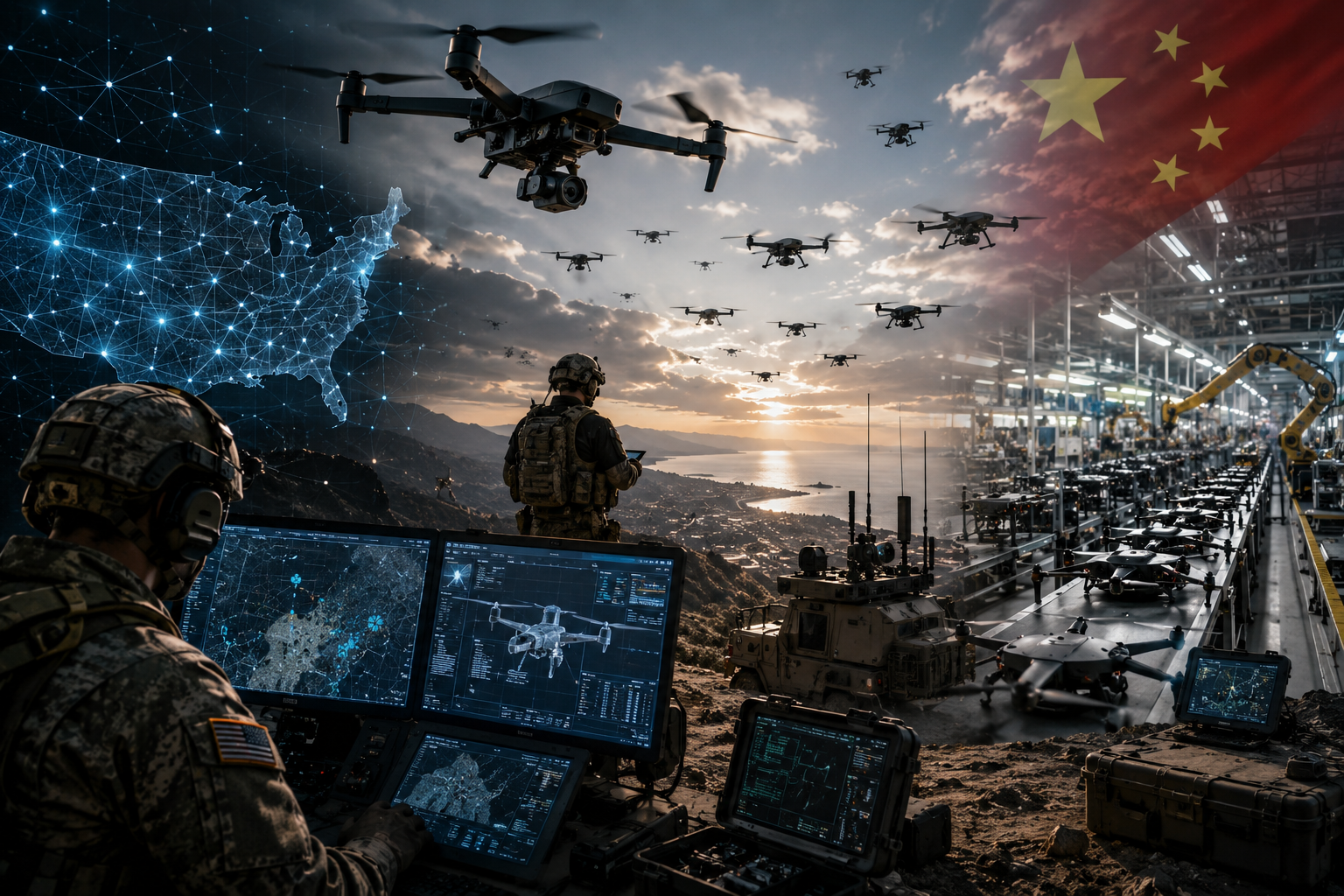
The U.S. drone challenge cannot be separated from China. While drones have demonstrated their effectiveness on modern battlefields, the greater concern for the Department of War is China’s dominance of the global drone ecosystem.
China controls significant portions of the world’s drone manufacturing capacity, battery production, electronics supply chains, rare earth materials, and the critical components required to build modern unmanned systems. DJI remains one of the most influential drone manufacturers in the world, but the challenge extends far beyond any single company. The concern inside the DoW is not simply that China can build drones.
It is that China can build them at scale.
Recent industry estimates suggest Chinese manufacturers can produce hundreds of thousands of FPV-class drones every month, with annual production measured in the millions. Some assessments estimate China’s broader drone ecosystem may already exceed eight million drones annually.
By comparison, the United States is still working to establish the manufacturing capacity necessary to support large scale domestic drone production and sustainment.
This production gap has become a strategic concern.
The Army’s objective to field up to one million drones over the next several years is not simply a procurement target. It reflects the reality that future conflicts may require autonomous systems to be produced, deployed, consumed, and replaced at a scale never before seen in modern warfare.
For the Department of War, the challenge is clear: the United States cannot depend on foreign controlled supply chains for technologies that may become foundational to future military operations.
As a result, the federal response extends far beyond purchasing drones. The DoW is investing in domestic manufacturing capacity, supply-chain resilience, autonomy software, secure communications, advanced batteries, electronic warfare capabilities, counter-drone technologies, and the broader industrial base required to support autonomous warfare.
In many ways, the drone arms race is no longer simply a competition between military platforms. It is a competition between industrial bases.
Follow the Money
The manufacturing gap with China is one of the primary reasons drones have become a major Department of War investment priority.
The FY27 Department of War budget proposal includes more than $74 billion dedicated to drones, autonomous systems, and counter-drone capabilities, representing the largest investment in drone warfare and counter-drone technology in U.S. history.
The request includes approximately $53.6 billion aligned to Drone Dominance initiatives, autonomous systems, contested logistics, and related modernization efforts. An additional $21 billion supports munitions, counter-drone systems, Collaborative Combat Aircraft, and other advanced capabilities critical to future warfare.
The scale of this investment sends a clear signal to industry. Autonomous warfare is no longer an experimental capability. It is becoming a foundational element of future military operations.
The Army’s objective to acquire up to one million drones over the next several years further illustrates the scale of demand military planners anticipate. That level of procurement creates opportunities far beyond the aircraft themselves.
Every drone requires software, communications, batteries, sensors, cybersecurity, logistics, maintenance, training, data management, and command-and-control infrastructure. As investment increases, the opportunity expands across the broader technology ecosystem.
The Market is Larger Than the Drone
One of the biggest misconceptions in the market is that only drone manufacturers can participate. The reality is very different.
The autonomous warfare ecosystem includes a broad range of technology categories, including artificial intelligence, autonomy software, edge computing, computer vision, cybersecurity, resilient communications, electronic warfare, navigation technologies, sensors, radar, command-and-control systems, battlefield analytics, advanced manufacturing, batteries, testing, simulation, and sustainment.
This is why the drone market should matter to companies far beyond traditional aerospace and defense contractors.
A cybersecurity company, AI platform provider, networking vendor, data analytics company, edge infrastructure provider, advanced manufacturing firm, or sensor company may all have a direct role to play in supporting future autonomous operations.
The opportunity extends far beyond the airframe.
Acquisition is Changing
The Department of War recognizes that traditional acquisition timelines are often too slow for emerging threats. The pace of drone innovation, lessons learned from Ukraine, and competition with China have created pressure to accelerate how technologies move from commercial development into operational deployment.
As a result, organizations across the DoW are increasingly relying on Commercial Solutions Openings (CSOs), Other Transaction Authorities (OTAs), rapid prototyping efforts, and commercial-first acquisition strategies. Recent reforms associated with the Warfighting Acquisition System (WAS), the establishment of Program Executive Acquisition organizations, and autonomous warfare initiatives are intended to reduce barriers between commercial innovation and operational requirements.
For technology companies, this creates opportunity. It also creates complexity.
Success requires understanding where budgets are being allocated, who owns the requirement, which acquisition pathway is being used, and whether the best route to market is direct engagement, partnership with a prime contractor, collaboration with a systems integrator, or participation in an innovation program.
Where Marion Square Sees the Opportunity
At Marion Square, we view the drone market as one of the most significant federal technology opportunities emerging today because it sits at the intersection of mission urgency, budget growth, industrial policy, acquisition reform, and commercial innovation. When the Department of War commits more than $74 billion to a technology area in a single budget cycle, companies should be asking where they fit within that ecosystem.
Most companies already understand that drones are important. The more important questions are:
Where is the funding being allocated?
Which organizations own the requirements?
Which programs are driving investment?
Which acquisition pathways are being used?
Which primes and integrators are positioning themselves?
Where does your technology fit within the ecosystem?
How should your company align its messaging with mission priorities?
These are the questions that determine whether a company successfully enters the market or simply watches from the sidelines.
The organizations that succeed will not necessarily be those with the most innovative technology. They will be the companies that understand how to align their capabilities with funded programs, urgent mission needs, acquisition priorities, and the rapidly evolving autonomous warfare ecosystem.
For technology companies, the question is no longer whether drones matter. The question is where your company fits within the future of autonomous warfare.