

Resources
Below you will find a collection of useful resources for companies that are interested in doing business with the federal government. Included are blog posts, news items, links to external resources and more. Use the filters and search to find exactly what you are looking for.

Technology companies entering the Government market spend enormous amounts of time thinking about agencies, programs, partners, contract vehicles and sales strategy.

Navigating the U.S. Federal market requires a clear understanding of legislative mechanics, shifting agency priorities, and strategic funding pathways.
Webinar recording from 9/1/2026

The civilian-agency topline is shrinking, but the demand for technology that reduces costs, consolidates operations, strengthens security, and improves mission delivery is not.

How multiple funding streams and the uncertainty surrounding them could reshape defense priorities and opportunities for technology vendors.

White House budget writers are using budget reconciliation to push massive tech bets outside standard appropriations. What are the risks for Tech Vendors?

The recently unveiled FY 2027 White House budget request is not an incremental adjustment to the federal ledger. It is a fundamental architectural restructuring of how the United States government buys, deploys, and funds technology.
Federal AI adoption is moving from strategy to execution. As agencies release FY27 budget requests and continue publishing AI use case inventories, vendors need to understand where AI is being prioritized, how agencies are framing mission needs and what signals point to future funding and procurement activity.
Webinar recording from 6/26/2026

The drone arms race is no longer a future concern. It is already underway.
From Ukraine to the Middle East, drones have fundamentally altered the economics of warfare. Low-cost unmanned systems are now capable of identifying, tracking, disrupting, and destroying assets worth hundreds or even thousands of times their cost. Drone swarms are forcing militaries to rethink battlefield tactics, force structure, logistics, and modernization priorities.
Federal agencies are actively preparing for the impact of quantum technologies on existing systems and security architectures. A recent report from the U.S. Government Accountability Office highlights an important reality: while strategy and direction are well established, agencies are still working to define practical approaches for implementation.
Webinar recording from 5/26/2026

At Marion Square we have been following the Federal AI market very closely, not that the FY 27 Budget Requests have been released, I wanted to share some perspective for both our AI vendor partners and the market in general.
The federal AI market in 2026 is no longer a playground for speculative pilots; it has transformed into a massive, operational machine. For vendors, the opportunity is staggering: potential award values for AI contracts have surged to nearly $92 billion, a nearly 2,000% increase from just two years ago.

The Presidents fiscal year 2027 budget request has arrived, and it marks a historic shift in how the U.S. government intends to spend taxpayer dollars. For companies looking to partner with the federal government, the headline is clear: overall defense spending is surging to unprecedented levels, while non-defense federal spending is being aggressively leaner.

A recent report from the U.S. Government Accountability Office provides a useful and overdue assessment of where the federal government actually stands on quantum.
The conclusion is not that the United States lacks strategy or commitment. In fact, the opposite is true. Federal investment, policy direction, and research activity around quantum technologies have been sustained and deliberate.
The issue, as the report makes clear, is that this strategy has not yet been translated into a consistent, government-wide execution model.

Most discussions around post-quantum cryptography (PQC) still frame it as a long-term concern something to monitor, plan for, and revisit in a few years.
That framing is now outdated.

We recently conducted a webinar with Carahsoft where we analyzed the federal market for artificial intelligence. The discussion wasn’t based on general market narratives or high-level strategy it was grounded in something much more practical: the AI use cases that federal agencies are required to publish.
These inventories, driven by policies such as Executive Order 13960 and the Advancing American AI Act, provide a directional view into where AI is actually being deployed across government.
AI adoption across the U.S. Federal Government is accelerating, bringing new priorities, funding opportunities and buying pathways. Stay competitive by understanding where agencies are investing in AI, how they plan to buy it and what vendors need to know to align with current government requirements.
Webinar recording from March 24, 2026

The U.S. government’s push to rapidly expand drone capabilities is creating one of the most significant emerging technology markets in defense and national security. But the opportunity goes far beyond building drones.
It includes AI, software, autonomy, communications, sensors, manufacturing, and supply chain infrastructure and for many technology companies, those layers represent the real entry point into the market.
The federal government is shifting from AI experimentation to AI procurement, and that shift requires something very different: rules governing how AI systems interact with government data, infrastructure, and decision-making processes.
A recently released draft clause from the General Services Administration titled “Basic Safeguarding of Artificial Intelligence Systems” provides one of the clearest signals yet of what those rules will look like.

The Department of War’s (DoW) newly released Acquisition Transformation Strategy marks the most consequential shift in defense buying in decades and it is being designed explicitly to unlock commercial technology at speed. While headlines focus on weapons and platforms, the real transformation is in how DoW intends to acquire software, data, AI, cyber, autonomy, digital infrastructure and mission applications across the enterprise.
Webinar recording from February 25, 2026
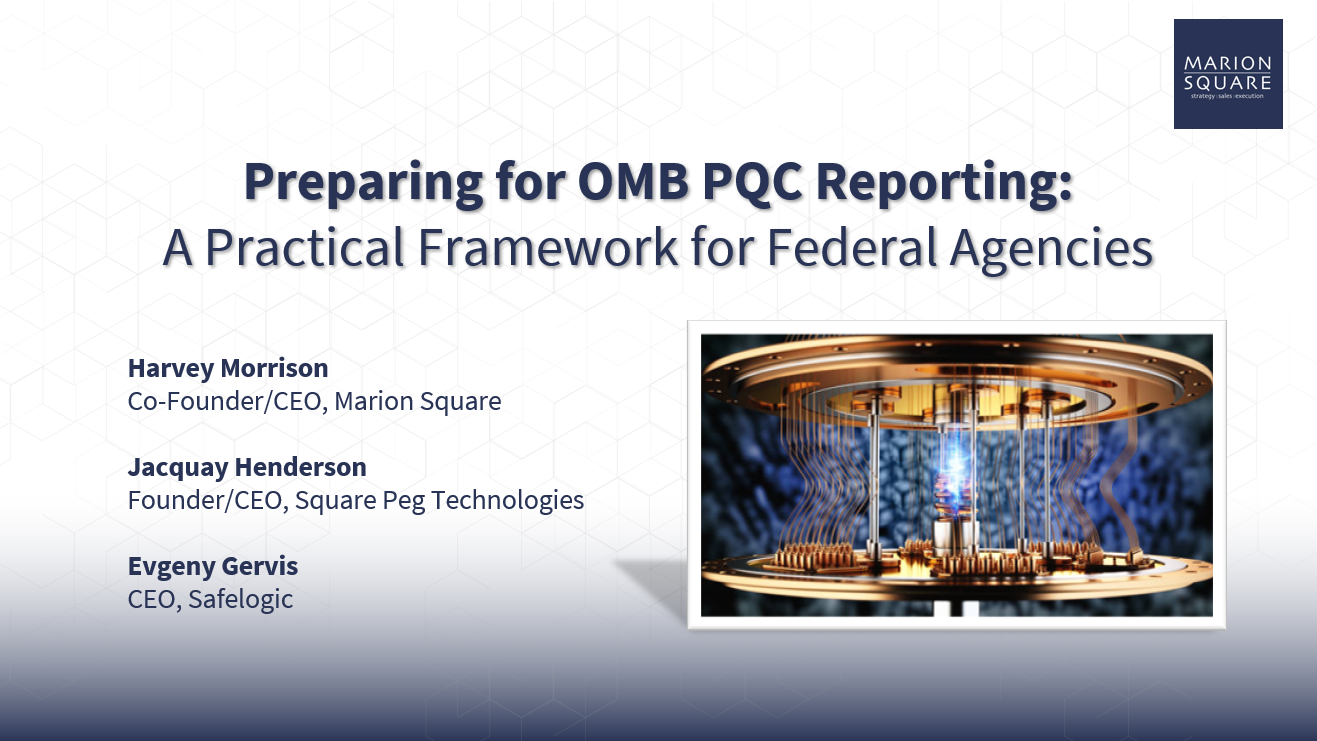
Federal agencies are now required under OMB Memorandum M-23-02 and National Security Memorandum-10 to inventory cryptographic assets, identify quantum-vulnerable algorithms and report progress toward post-quantum cryptography (PQC) readiness. Yet many agencies are unsure what these mandates actually require in practice, how discovery and inventory tools fit into compliance or how to determine whether their current environments provide sufficient cryptographic visibility.
Webinar recording from February 19, 2026

For years, selling software into the federal government often meant pursuing a large program opportunity, negotiating a broad deployment, and structuring a multi-year agreement from the outset. Even when pilots were used, they were often treated as stepping stones toward immediate enterprise adoption.

Quantum sensing is post feasibility but pre-scale. The market is moving from RDT&E into transition activity, characterized by operationally relevant testing, platform integration pilots, and limited early procurements rather than broad programs of record.
This post is Part Two of a Marion Square blog series examining the Department of War’s shift to the Warfighting Acquisition System and what it means for commercial technology vendors.
The new acquisition strategy responds to this reality by introducing something DoW did not previously have in a formal, empowered way: portfolio level ownership of digital and software capabilities.
That is where the new Portfolio Manager role comes in.
One thing is clear these days: the federal tech landscape is not standing still. Agencies are under more pressure to justify spend, defend outcomes, and align investments directly to mission objectives. Whether you are sharpening your federal messaging or entering the space for the first time, the rules of engagement are shifting.

The Department of Health and Human Services (HHS) has published a comprehensive Artificial Intelligence Strategy outlining how AI will be governed, deployed, and scaled across healthcare delivery, public health, and research.
While the FY 2026 HHS Budget does not create a single “AI program,” it does fund the strategy in practice through investments in technology modernization, data infrastructure, public health analytics, digital health, and research systems.
Last week’s release of Transforming the Defense Acquisition System into the Warfighting Acquisition System is likely the most consequential change in defense acquisition policy in decades and it sends a very clear message to the industrial base, startups, and commercial vendors:
Speed, modularity, and mission impact now outrank process, compliance, and tradition.
For companies building AI, cybersecurity, PQC, quantum, edge compute, cloud, analytics, sensors, or advanced manufacturing technologies, this is not just a policy update.
It’s an open door.

The headlines are all about gridlock: the Senate racing to pass a three-bill “minibus,” the House waiting for the green light, and another short-term continuing resolution (CR) keeping the lights on only through January 30. It’s tempting to read this as a signal for technology companies to pause their government efforts.
That would be a mistake.
While Washington wrestles over process, the underlying mission priorities driving government IT, cybersecurity, and AI investments haven’t changed. Agencies are still under binding mandates from Zero Trust and post-quantum encryption to AI governance and data modernization that require continued action regardless of the budget dance on Capitol Hill.
At Marion Square, we see this as one of the best times to be positioning for growth.

When Congress fails to pass funding legislation, the federal government officially shuts down. For federal contractors, a shutdown introduces a period of significant uncertainty, affecting ongoing projects, payment schedules, and future business opportunities.

The federal government’s FY26 budget cycle begins October 1st, and agencies are already shaping acquisition plans. Billions are being directed toward AI, cybersecurity, post-quantum readiness, infrastructure, and defense making this one of the largest opportunities yet for technology companies
Whether you’re already working with federal agencies or just starting to explore the market, the message is clear: the time to act is now.

Many organizations make the mistake of treating quantum readiness and the deployment of a Zero Trust Architecture (ZTA) as distinct initiatives. In this webinar, ISARA and Marion Square discuss the connections between these two undertakings and explain why having a strong cryptographic posture management program is indispensable to adopting a Quantum-Ready ZTA.
Webinar recording from August 12, 2025

On August 6, 2025, Senators Gary Peters (D-MI) and Marsha Blackburn (R-TN) introduced bipartisan legislation that could significantly accelerate the nation’s migration to post-quantum cryptography (PQC). The bill, known informally as the National Quantum Cybersecurity Strategy Act, underscores a growing federal urgency: quantum computing is no longer just a research milestone it’s a looming cybersecurity disruptor.
For technology providers, government contractors, and agencies alike, this legislation represents both a challenge and a market defining opportunity.