
The Pentagon’s Drone Push is Creating a Massive Technology Market
Harvey Morrison: Co-Founder/CEO, Marion Square
The U.S. government’s push to rapidly expand drone capabilities is creating one of the most significant emerging technology markets in defense and national security.
But the opportunity goes far beyond building drones.
It includes AI, software, autonomy, communications, sensors, manufacturing, and supply chain infrastructure and for many technology companies, those layers represent the real entry point into the market.
Recent developments from the U.S. Army highlight just how large this opportunity is becoming.
The Army Is Opening the Market to Commercial Technology
The U.S. Army recently launched a UAS (Uncrewed Aircraft System) Marketplace, using a Commercial Solutions Opening to attract innovative technologies from industry. The goal is simple: rapidly scale the industrial base and accelerate the deployment of drone capabilities to soldiers in the field.
Instead of relying solely on traditional defense programs, the Army wants:
Commercial drone platforms
Software for autonomy and mission planning
Targeting and navigation systems
Counter-drone technologies
Advanced manufacturing capabilities
Component suppliers
This marketplace model allows the military to pull innovation directly from the commercial technology sector. For companies that have never sold to the government before, this type of program lowers the barrier to entry.
The Drone Opportunity Is Much Bigger Than Hardware
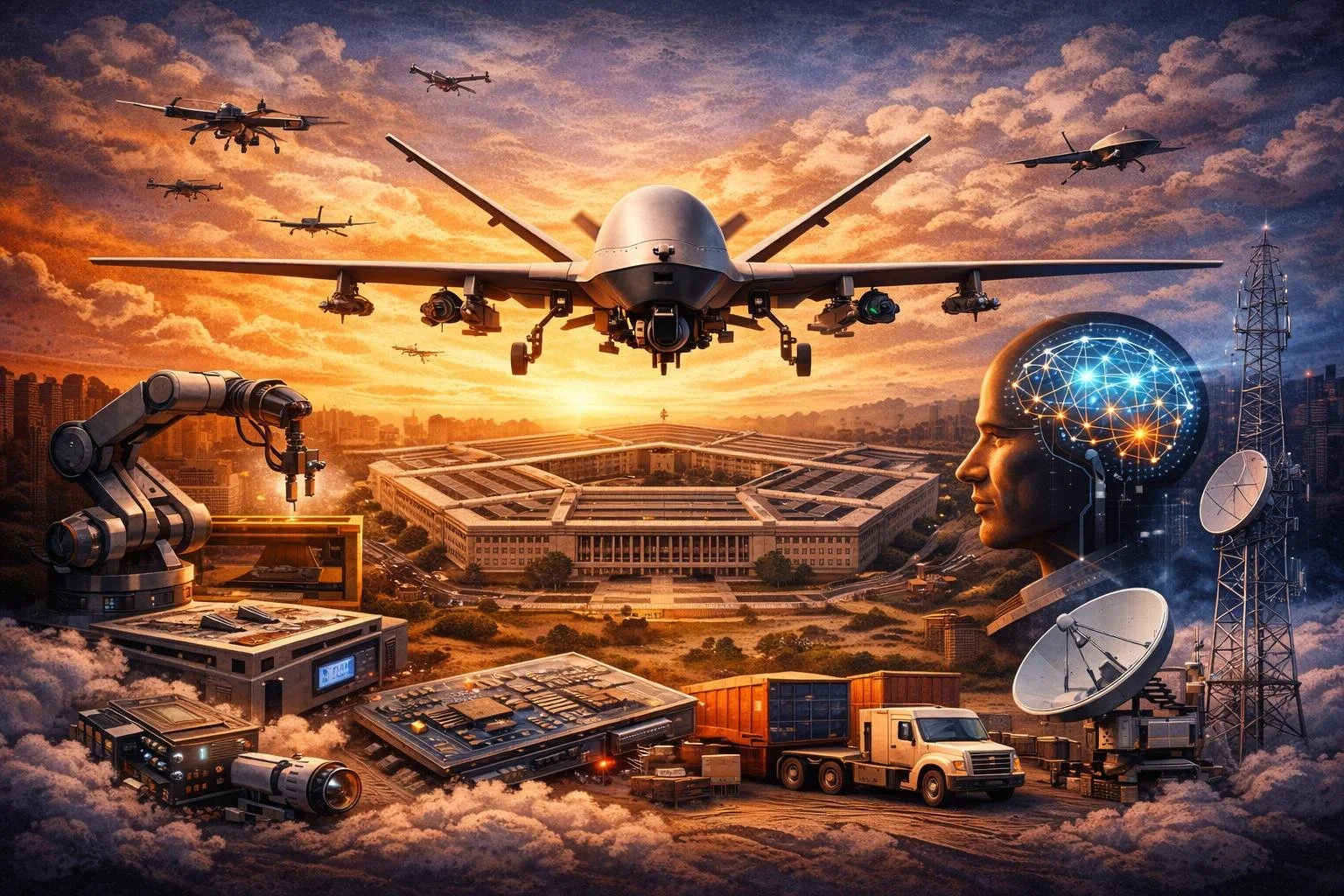
When most people think about the drone market, they think about the aircraft itself. But in reality, the drone ecosystem looks more like a technology stack.
The Drone Technology Stack
1. Airframe and propulsion
Airframe manufacturing
Motors and propulsion systems
Batteries and power systems
2. Sensors and payloads
Cameras
LIDAR
Electronic warfare sensors
ISR payloads
3. Navigation and autonomy
AI navigation software
GPS-denied navigation
Computer vision
Swarm coordination
4. Mission software
Targeting
Intelligence analysis
Mapping
Edge AI processing
5. Communications
Mesh networking
Secure communications
Satellite links
6. Manufacturing and supply chain
Additive manufacturing
Rapid prototyping
Component production
secure electronics supply chains
Many of these areas represent billion dollar markets themselves. For software companies, AI companies, and advanced manufacturing firms, drones may simply be the platform where their technology is deployed.
The Supply Chain Problem No One Talks About
While the U.S. government is pushing to scale drone production, there is a major structural problem. The global drone supply chain is dominated by China.
In fact, Chinese manufacturers control a large share of the commercial drone market and many of the critical components used in drone production.
Key components commonly sourced from overseas include:
Motors
Batteries
flight controllers
electronic speed controllers
camera modules
Even drones approved by the U.S. government sometimes rely on foreign components, particularly motors and batteries. This creates both security risks and supply chain vulnerabilities.
NDAA Compliance Is Becoming a Major Market Driver
Because of these concerns, the U.S. government has implemented strict rules around drone procurement. One of the most important is Section 848 of the National Defense Authorization Act (NDAA). This law restricts the Department of Defense from purchasing drones or components produced by certain foreign manufacturers, particularly those tied to China. Additional policies have expanded these restrictions across the federal government.
In parallel, the Pentagon launched the Blue UAS program, which identifies drones and components that meet security and supply-chain standards for government use.
The Blue UAS catalog now includes:
dozens of approved drone platforms
hundreds of vetted components
For companies in the drone ecosystem, becoming NDAA compliant or Blue UAS approved can be the difference between accessing the federal market or being locked out entirely.
Manufacturing Is Becoming a Strategic Capability
Another emerging trend is advanced manufacturing, particularly additive manufacturing and distributed production. Defense planners increasingly recognize that drones must be produced quickly, at scale, and sometimes close to the battlefield.
Additive manufacturing technologies are being explored to:
rapidly produce drone parts
repair damaged systems in the field
reduce reliance on fragile global supply chains
This approach allows militaries to design, manufacture, and deploy drones far faster than traditional defense acquisition cycles allow.
The Industrial Base Opportunity
The result is the emergence of a new defense industrial ecosystem around drones.
It includes:
Hardware companies
Airframes, propulsion, sensors
Software companies
AI navigation, autonomy, mission planning
Cybersecurity firms
Secure communications and drone networks
Manufacturing companies
Additive manufacturing and component production
Semiconductor and electronics companies
Secure chips and embedded systems
In many ways, this resembles the early days of the cybersecurity market or the space economy where a new platform creates dozens of adjacent technology opportunities.
Why This Matters for Technology Companies
For technology vendors looking at the federal market, drones represent something important: A platform market.
Just as smartphones created ecosystems for apps, sensors, and chips, drones are creating ecosystems for:
AI
edge computing
navigation software
sensor fusion
manufacturing technologies
The companies that win in this market may not be the drone manufacturers themselves. They may be the companies that provide the software, AI, components, and supply-chain infrastructure that make drone operations possible.
The Strategic Bottom Line
The United States is entering a period where drone dominance is becoming a national priority.
Congress and defense leaders have emphasized the need to rebuild the American drone industrial base and reduce reliance on foreign suppliers. As a result, the drone market is evolving into something much larger than a single product category.
It is becoming a full technology ecosystem spanning AI, software, manufacturing, cybersecurity, and supply chains.
For technology companies willing to navigate federal procurement and compliance requirements, this ecosystem represents one of the most significant opportunities in the defense market today.